
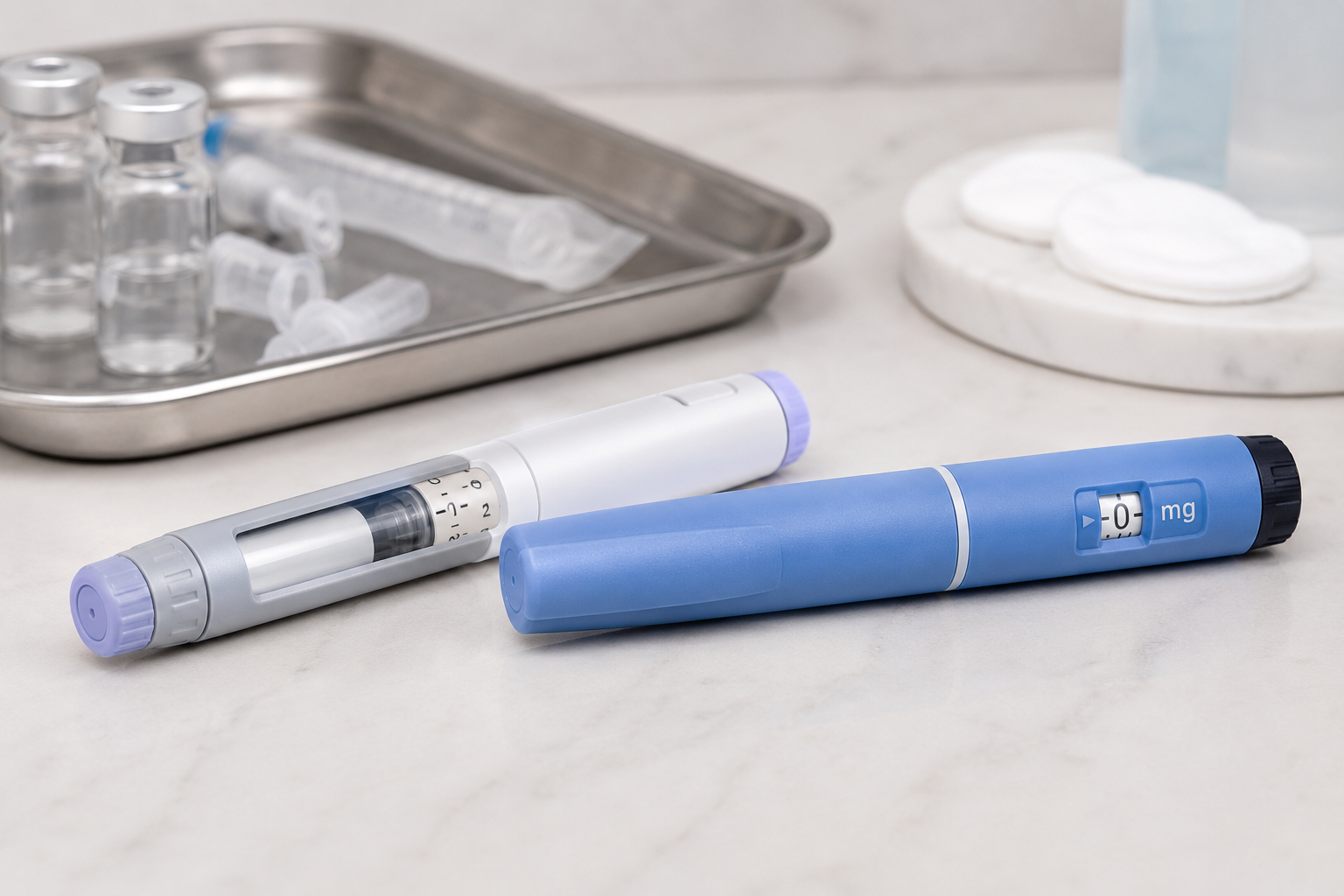
Studies have estimated roughly 35,000 adults in the U.S. live with growth hormone deficiency, and treatment almost always comes down to choosing between a handful of FDA-approved somatropin brands.
Omnitrope and Norditropin are two of the most commonly prescribed options. Both contain the same active ingredient, but they differ in manufacturer, delivery device, and dosing structure.
We’ll explain exactly how Omnitrope and Norditropin compare, what the research says about switching between them, and where to access either brand legally.
Omnitrope vs. Norditropin: A Quick Comparison
Both medications are biosimilar in effect. Let’s compare Omnitrope vs Norditropin at a high level.
| Omnitrope | Norditropin | |
| Manufacturer | Sandoz | Novo Nordisk |
| Active ingredient | Somatropin | Somatropin |
| FDA approval year | 2006 | 2000 |
| Delivery device | Prefilled cartridge or powder vial | FlexPro prefilled pen |
| Available strengths | 5mg/1.5mL, 12mg/1.5mL (cartridge); 5.8mg (vial) | 5mg, 10mg, 15mg per 1.5mL; 30mg per 3mL |
| Controlled substance? | No | No |
What Are Omnitrope and Norditropin Used For?
Both brands are FDA-approved to treat growth hormone deficiency (GHD) in adults and children, along with several related growth conditions. Here’s where their approved uses overlap and differ:
| Condition | Omnitrope | Norditropin |
| Adult GHD | ✔ | ✔ |
| Pediatric GHD | ✔ | ✔ |
| Turner syndrome | ✔ | ✔ |
| Prader-Willi syndrome | ✔ | ✔ |
| Idiopathic short stature | ✔ | Not listed by FDA |
| Small for gestational age | ✔ | ✔ |
| Noonan syndrome | Not listed by FDA | ✔ |
| Boosting metabolism for weight loss support | Not listed by FDA | Not listed by FDA |
If you’re deciding between the two, our breakdown of what Omnitrope actually is and our guide to Norditropin cover each medication in more depth.
Omnitrope Injection vs. Norditropin: How Each Is Administered
Omnitrope injection is given subcutaneously into the abdomen, buttocks, or thigh. Its dosing is based on body weight and the condition being treated. HGH Meds’ Omnitrope 3-pack comes as a pre-mixed cartridge. Since the medication is already reconstituted, it can be drawn and injected with a standard diabetic needle instead.
Norditropin uses the FlexPro pen, a prefilled, ready-to-inject device available in four fixed strengths. Adults typically inject daily. HGH Meds’ Norditropin 3-pack includes the FlexPro pen with its dose window display, so no extra mixing or diabetic needles are needed.
Neither device requires a physician visit for every dose once you’ve been evaluated, but a provider will show you or a caregiver how to administer injections safely before you start treatment at home.
For getting started, our overview of buying Omnitrope online covers what the evaluation and dispensing process looks like.
Omnitrope Side Effects vs Norditropin Side Effects
Both medications share a similar side effect profile, since they contain the same active ingredient. Common side effects include:
- Injection site reactions, such as pain, redness, or lipoatrophy
- Headache
- Joint, muscle, or back pain
- Fluid retention and swelling
More serious but less common side effects for both include intracranial hypertension, pancreatitis, and changes in blood sugar regulation that can affect diabetes risk.
Norditropin carries an additional risk of carpal tunnel syndrome. Always review your medication’s full prescribing information and talk with your provider before treatment.
Cost Comparison: Omnitrope vs. Norditropin
Pricing varies by pharmacy, dose, and total quantity. Here’s how standard U.S. pharmacy pricing stacks up to HGH Meds pricing on a cost-per-mg basis:
| GoodRx Total / Price | GoodRx $/mg | HGH Meds Total / Price | HGH Meds $/mg | |
| Omnitrope | 30mg (3 cartridges) / $4,021 | $133.97/mg | 30mg / $1,250 | $41.67/mg |
| Norditropin | 45mg (3 FlexPros) / $7,888 | $175.29/mg | 30mg / $1,349 | $44.97/mg |
If you want a deeper cost breakdown, our full guide to Norditropin pricing walks through the numbers by pack size.
Is It Legal to Buy Omnitrope or Norditropin?
Both are prescription-only medications in the United States, and legally accessing either one requires a diagnosis from a licensed provider. This is true whether you’re seeing a U.S. endocrinologist or working with a licensed clinic abroad.
HGH Meds is a licensed health clinic in Mexico and follows SAT and COFEPRIS standards, allowing us to legally dispense medication following a proper evaluation. All of our HGH is pharmacy-grade and FDA-approved, sourced directly from each manufacturer’s headquarters in Mexico. The same distributor and clinic are the only parties that ever handle your medication before it reaches you.
Which Should You Choose: Omnitrope or Norditropin?
Since both medications are biologically equivalent and FDA-approved for overlapping conditions, the right choice usually comes down to a few practical factors:
- Device preference: Norditropin’s FlexPro pen is prefilled and ready to use, while HGH Meds’ Omnitrope cartridge is used with a diabetic needle rather than its brand pen.
- Approved condition: Both are approved for GHD, Turner syndrome, Prader-Willi syndrome, and children with SGA (small for gestational age). Omnitrope is also approved for idiopathic short stature, while only Norditropin is approved for Noonan syndrome.
- Cost: Pricing differs by pack size and pharmacy, so it’s worth comparing your specific prescribed dose across sources.
- Provider guidance: Your prescribing physician will ultimately confirm which brand fits your diagnosis, weight, and treatment history.
Frequently Asked Questions About Omnitrope vs Norditropin
1. What’s the main difference between Omnitrope and Norditropin?
Both contain the same active ingredient, somatropin, and are equally effective for treating growth hormone deficiency. The real differences come down to:
- Manufacturer: Omnitrope is made by Sandoz, while Norditropin is made by Novo Nordisk.
- Delivery device: Omnitrope comes in a cartridge or vial, while Norditropin uses the FlexPro prefilled pen.
- Specific approved conditions: Each brand covers slightly different FDA-approved uses.
This depends on how well the delivery system works for both.
2. How is my dosage determined for Omnitrope or Norditropin?
Dosage isn’t standardized. It depends on several factors your provider evaluates during your treatment plan:
- Body weight, since both medications are typically dosed in mg per kg.
- Age, as pediatric and adult dosing guidelines differ.
- Conditions being treated, since GHD, Turner syndrome, and other approved uses each carry their own recommended ranges.
- Response to treatment, as your provider may adjust your dose over time based on how your body responds.
Your prescribing physician will determine the right starting dose and monitor your progress from there, rather than following a one-size-fits-all amount.
3. What are the most common Omnitrope side effects?
The most frequently reported Omnitrope side effects include:
- Injection site pain or skin changes
- Headache
- Joint or limb pain
- Fluid retention
Most of these are mild and resolve within a few days to weeks. Contact your provider if side effects persist or worsen.
4. Is Omnitrope injection difficult to learn?
No. A provider will train you or a caregiver on proper technique before you start home treatment. Omnitrope injection is given subcutaneously into the abdomen, buttocks, or thigh, with the injection site rotated each time to avoid skin damage.
5. Are Omnitrope and Norditropin available as generic medications?
No. Both are biologic drugs, which means they’re manufactured using living cells rather than standard chemical processes. This affects how “generic” versions work:
- Traditional drugs can have exact-copy generics because their chemical structure is simple to replicate.
- Biologic drugs like Omnitrope and Norditropin cannot be copied exactly, so they don’t have true generics.
- Biosimilars are the closest equivalent for biologics, considered as safe and effective as the original but not identical copies.
- Current status: neither Omnitrope nor Norditropin currently has an approved biosimilar version on the market.
This is part of why pricing for both brands tends to stay higher than typical generic prescription drugs. Neither has direct lower-cost competition from a generic manufacturer.
6. What should I do if I miss a dose of Omnitrope or Norditropin?
For both medications, the general guidance is similar, though your provider’s specific instructions should always take priority:
- If you remember soon after the missed dose, inject it as soon as you remember, then continue your regular schedule.
- Don’t double up, since taking two doses close together isn’t recommended for either medication.
- Resume your usual injection time for the next scheduled dose.
- If you’re unsure what to do, contact your provider rather than guessing, since missed-dose guidance can vary based on your specific treatment plan.
7. Is it legal to buy Omnitrope or Norditropin without a prescription?
No. Both are prescription-only medications requiring a diagnosed medical need confirmed by a licensed provider. This applies whether you’re sourcing through a U.S. doctor or a licensed clinic like HGH Meds.
8. Does HGH Meds offer both Omnitrope and Norditropin?
Yes. HGH Meds carries both Omnitrope (Sandoz) and Norditropin (Novo Nordisk), sourced directly from each manufacturer, along with Genotropin and Ngenla (Pfizer). All products are pharmacy-grade, dispensed through our COFEPRIS-licensed clinic following an in-person evaluation.


